ELLs in the Sociocultural Context
Introduction
Understanding ELLs within their sociocultural context is fundamental to effective teaching. Through Module 3, I've developed a framework for establishing positive communication with ELLs and their families, recognizing that language learning extends beyond the classroom into the rich tapestry of students' cultural identities, family dynamics, and community connections.
Reflection on Module 3 Learning
- Funds of knowledge: Look at ELs and their families as holders of community expertise. This reframes "language gaps" as assets to build upon.
- Culturally sustaining pedagogy: Language instruction should validate home languages and literacies, not replace them. Translanguaging is a resource for meaning-making.
- Ecologies of support: Effective EL instruction depends on school–family–community partnerships; communication must be two-way, multilingual, and relationship-centered.
- Power and access: Barriers often stem from systems (scheduling, jargon, transportation, documentation fears). Equity means redesigning these conditions, not "fixing" families.
Guiding Principles for Positive Communication with ELs and Families
Relationship before information
Start with welcome calls/home visits, name pronunciation checks, and interest inventories. Use strengths-first language: "Your child is multilingual and brings rich experiences…"
Linguistic access as a right
Provide translated notices and interpretation for meetings. Use plain language, visuals, and multimodal communication (texts, voice notes, short videos).
Two-way dialogue
Ask families how they prefer to be contacted and at what times. Invite feedback regularly (quick pulse surveys in home languages; option to reply via voice).
Cultural humility and co-learning
Ask families about goals for schooling and language use at home/community. Avoid assumptions; check understanding and invite corrections.
Consistency and transparency
Share learning targets and rubrics in accessible formats. Provide predictable communication rhythms (e.g., Friday learning snapshot).
Asset-oriented storytelling
Share specific examples of students' progress with photos, captions, and short audio notes when permitted.
Tools for Learning About ELLs
| Tool | Purpose | Implementation |
|---|---|---|
| Multilingual Surveys | Gather information about language backgrounds, interests, and educational experiences | Distribute at beginning of year; available in multiple languages; include visual supports |
| Digital Storytelling | Allow students to share their experiences and cultural backgrounds | Guide students in creating short videos or audio recordings about their family traditions |
| Family Interviews | Learn about family educational values and aspirations | Conduct through phone calls, home visits, or virtual meetings with interpreters |
| Cultural Portfolios | Document students' cultural identities and linguistic repertoires | Students compile artifacts, photos, and writings that represent their cultural background |
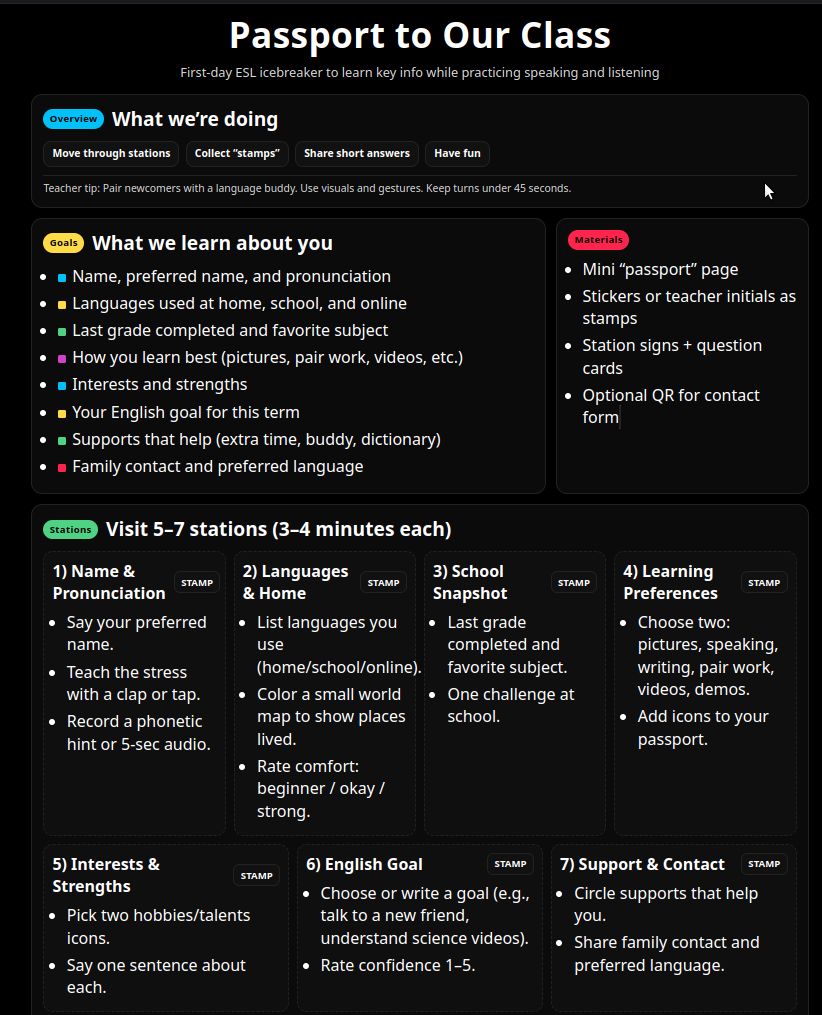
This activity was designed as a part of my course (see Appendix).
Bridging Families with School Community
Family Engagement Framework
- Welcoming Environment: Multilingual signage, family resource center, culturally responsive decor
- Regular Communication: Weekly newsletters in multiple languages, class website, text messaging system
- Family Education: Workshops on navigating the school system, supporting literacy at home, understanding assessments
- Collaborative Leadership: Include family representatives on school committees and decision-making processes
Resources for Promoting Parental Involvement
| Resource | Purpose | Target Audience |
|---|---|---|
| Bilingual Family Handbook | School policies, procedures, and resources explained in accessible language | New families, especially those unfamiliar with the U.S. school system |
| Vocabulary Picture Dictionaries | Help families learn school-related terminology in English | Parents with beginning English proficiency |
| Digital Communication Platform | Real-time translation for teacher-family messaging | All families, especially those with technology access |
| Community Resource Guide | Information about local services, libraries, and cultural organizations | Newcomer families needing community connections |
Classroom Activities to Welcome and Include EL Families

This activity was designed as a part of my course (see Appendix).
Family Literacies Gallery
Students and families contribute artifacts (recipes, songs, proverbs, letters). Students curate captions in both languages.
Community Mapping Project
Learners map meaningful places, interview family/community members, and present in mixed-language formats.
Heritage Language Days
Peer teaching: students teach classmates key phrases, songs, or games from home languages.
Co-creation Conferences
Student-led conferences where learners share goals, work samples, and next steps with bilingual supports.
Translanguaging Circles
Small-group discussions where students can plan in L1 and present in English, with visuals and sentence frames.
Family-as-Expert Series
Invite parents to share skills (gardening, coding, crafts, entrepreneurship) connected to units.
Intergenerational Projects
Partner with students to interview family members about their immigration journeys, creating a class "Heritage Quilt" or digital storytelling project.
Cultural Showcases
Celebrate diversity through food fairs, music performances, or guest speakers from the community.
Digital Toolkit for Family Engagement
Recommended Multilingual Platforms
- ClassDojo: Messaging with translation features
- Remind: Text notifications in multiple languages
- Bloomz: Comprehensive family communication platform
- Seesaw: Digital portfolios with family access
Translation Resources
- School-provided interpretation services for meetings
- Google Translate with caution for simple phrases
- Bilingual community volunteers for translation support
- Picture-based instructions for common school activities