Planning and Instruction
Introduction
Reflection on Modules 3–4
- Backward design with language: Planning content and language outcomes together, aligning to standards (e.g., WIDA Language Development Standards + content standards). Language is not an add-on; it's a target.
- Functional language focus: Identify the disciplinary language functions first (explain, argue, describe, compare) and the linguistic features students need to use them (connectors, verb forms, nominalization, text structures).
- Multimodal scaffolding: Strategic use of visuals, models, sentence frames, and collaborative routines moves learners toward independence, not dependency.
- Assessment as learning: Frequent, low-stakes formative checks (oral, written, visual) inform immediate scaffolding adjustments.
My Guidelines for Successful Language Learning Experiences
Based on my reflections, I've developed these core guidelines for my planning and instruction:
Anchor Lessons in Authentic, Goal-Oriented Tasks
Guideline: Every lesson culminates in a primary task that requires students to use the target language to achieve a real-world objective (e.g., plan a trip, negotiate a solution, describe a process to a colleague).
In Practice: This is the "why" of the lesson. Instead of "learn the past tense," the goal becomes "tell a story about a memorable childhood event." This provides immediate context and relevance, making the language learning purposeful for adult learners.
Scaffold Rigorously to Bridge the Gap
Guideline: Break down the final task into manageable steps, providing the language, strategies, and support needed for all students to succeed. The mantra "I do, We do, You do" guides this process.
In Practice: Use authentic materials (menus, news clips, brochures) and adapted materials (simplified texts with key vocabulary highlighted). Visual aids, graphic organizers, and sentence frames are essential tools in my classroom to make challenging input comprehensible.
Prioritize Productive Struggle and Collaborative Practice
Guideline: The teacher is a facilitator. The classroom must be a safe space for trying and even making mistakes. Learning happens when students grapple with language together.
In Practice: Plan for think-pair-share activities, structured group work, and peer feedback sessions. This reduces reliance on the teacher as the sole source of knowledge and builds a community of learners.
Embed micro-instruction on language features
Guideline: Contrastive analysis moments: compare how a feature works across languages when relevant.
In Practice:
Mini-lessons on connectors, hedging, passive voice, nominalization, and discipline-specific phrasing.
Assess formatively and often
Guideline: Track both content mastery and language growth with simple rubrics aligned to objectives.
In Practice:
Use quick oral checks, whiteboards, exit tickets with visuals, and one-minute audio reflections.
Normalize strategy instruction
Guideline: Teach and model reading strategies
In Practice: Preview, chunk, annotate, summarize, take notes, and use glossaries/translation tools ethically.
UNIT PLAN DESIGN ANCHOR CHART
The chart was created as a part of my course assignment (see Appendix).

Bridging the Language Gap: Materials and Resources
| Resource Type | Examples | Purpose |
|---|---|---|
| Visual and graphic supports | Content-aligned picture banks and icon sets, Graphic organizers (Frayer model, cause–effect chain, claim–evidence–reasoning), Anchor charts with sentence starters and language moves | Make abstract concepts concrete and provide language support |
| Text scaffolds | Leveled texts on the same topic; text sets with varying modalities, Glossed texts with embedded definitions and audio-read versions, Bilingual glossaries for each unit | Provide accessible reading materials at appropriate language levels |
| Technology | Read-aloud and annotation tools (e.g., Immersive Reader, Kami), Translation with caution: demonstrate checking meaning, not copying, Voice recording for oral rehearsals; captioned short videos | Enhance accessibility and provide multiple modalities for engagement |
| Collaboration tools | Shared slides/whiteboards for co-constructing notes, Discussion platforms that support audio, images, and short text | Facilitate interaction and collaborative learning |
Independent Practice Pathways for Students
Daily language workout (5–8 min)
Micro-writing with a target connector set
Oral rehearsal with a peer or voice memo responding to a prompt
Choice-based practice menus
Vocabulary: create a sketch-note, Frayer model, or mini-dialogue
Reading: annotate a short text; record a 60-second summary
Speaking: rehearse with a prompt + frames; submit audio
Grammar in context: revise a sentence to add precision (appositives, adverb clauses)
Home language leverage
Read a short source in L1, then produce an English summary with visuals
Build a bilingual concept map before drafting in English
Spaced review
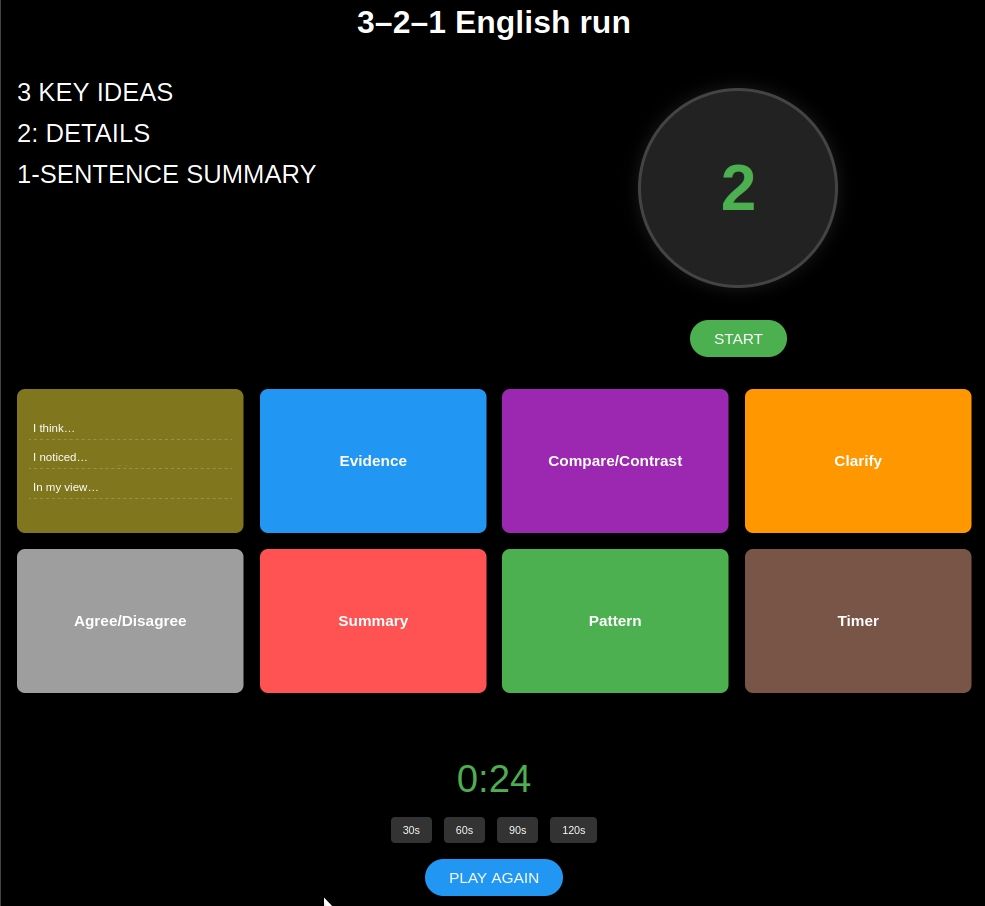
3–2–1 weekly reflections (3 new words/phrases, 2 strategies, 1 question)
Retrieval practice using self-made flashcards with images/examples
The game was designed as a part of my course assignment (see Appendix).
Sample Lesson Sketch: Putting It All Together
Objective:
Students will be able to describe a simple process (e.g., cooking a dish, using an app) using sequencing language (First, Then, Next, After that, Finally) and the imperative mood.
Lead-In (Activate Schema):
Show a short, fun video of someone making a paper airplane without words. Ask "What is he doing? What are the steps?"
Input & Scaffolding:
I Do: Model the language by explaining how to make coffee. Use visuals for each step and write the sequencing words on the board.
We Do: Give students a jumbled series of images showing how to use an ATM. In pairs, they use sentence frames (First, you ___. Then, you ___.) to put the steps in order.
Authentic Task (You Do):
In small groups, students choose a simple process and create a short video or live demonstration explaining it to the class. They must use the target language.
Extension for Autonomy:
I would suggest students try explaining their morning routine to themselves in the mirror using this language, or watch a "how-to" video on YouTube in English and note the sequencing words used.
Lesson Planning Template (Compact)
Standards:
Content + WIDA/Linguistic targets
Objectives:
Content: …
Language: Function + features + modality (listen/speak/read/write)
Language Demands:
Vocabulary: Tier 2/3 words; word parts
Syntax/Discourse: sentence starters, text structures, connectors
Materials/Texts:
Modalities and accessibility notes
Anticipatory Set:
Connect to prior knowledge; preview visuals
Explicit Instruction:
Model content and the target language move
Guided Practice:
Collaborative routine with frames; teacher confers/formative checks
Independent Practice:
Scaffolded choice; translanguaging options
Formative Assessment:
Criteria-aligned quick check; plan to reteach
Differentiation:
Newcomer, developing, and advanced supports; IEP/504 considerations
Reflection:
What worked? Evidence? What to adjust next?
Sample Language Objectives by Content Area
| Content Area | Language Objective |
|---|---|
| Science | Students will describe processes using temporal connectors (first, next, then, finally) and labeled diagrams. |
| Math | Students will justify solutions orally using precise math vocabulary (sum, ratio, increase/decrease) and comparative language (greater than, less than). |
| ELA | Students will cite textual evidence using reporting verbs (argues, suggests, claims) and quote integration. |
| Social Studies | Students will compare perspectives using contrastive connectors (however, whereas, on the other hand) and modal verbs to hedge claims. |
Formative Assessment Toolkit
- Exit tickets with dual targets (content + language)
- Single-point rubrics highlighting target language features
- Conferencing checklists (comprehensibility, accuracy, complexity)
- Speaking frames progression (from sentence to paragraph)
- Error logs for growth: track patterns; teach one high-leverage correction at a time
Differentiation Snapshot
| Proficiency Level | Support Strategies |
|---|---|
| Newcomers | Heavy visuals/realia; bilingual supports; partner talk in L1; product options (labeled diagrams, matching tasks). |
| Developing | Sentence/paragraph frames; modeled paragraphs; guided notes; increased output expectations. |
| Expanding/Bridging | Genre-specific conventions; academic vocabulary nuance; peer review; independent research tasks. |