Leadership
Introduction
This section articulates my leadership stance. Drawing on Modules 1–6, I describe how I will collaborate across roles to improve instruction for multilingual learners (MLs/ELLs), stay informed on policies and legislation, and advocate for students' rights and opportunities.
Leadership Lens: Why Collaboration Matters for ELL Success
- Shared responsibility: Language development occurs in every classroom. Co-planning ensures content teachers understand language demands and supports.
- Coherence for students: When ESL, special education, counselors, and content areas align, students experience consistent scaffolds and expectations.
- Professional growth: Collaboration surfaces blind spots, spreads effective routines, and normalizes translanguaging and accessibility.
My Collaboration Practices
Co-planning and co-teaching
- Weekly huddles with content teachers to pair content and language objectives, select target language functions (explain/argue/compare), and agree on scaffolds and assessments.
- Rotate co-teaching models (station, parallel, team teach) based on lesson purpose; debrief with quick evidence (work samples, exit tickets).
Shared tools and data
- Common lesson templates with language features, sentence frames, and multilingual resources.
- Domain-level dashboards (listening/speaking/reading/writing) using WIDA or state ELP data + classroom artifacts; use in PLCs to plan supports.
Capacity building
- Short "strategy spotlights" in staff meetings (5-minute demos of talk routines, single-point rubrics, or bilingual glossaries).
- Open-classroom invites for peers to observe language-rich routines; offer reciprocal observations and feedback.
Family and community partnerships
- Coordinate interpreters; co-host multilingual family workshops on navigating school systems, assessment reports, and supporting literacy at home.
- Connect with local libraries, adult ESL, and cultural organizations to extend learning.
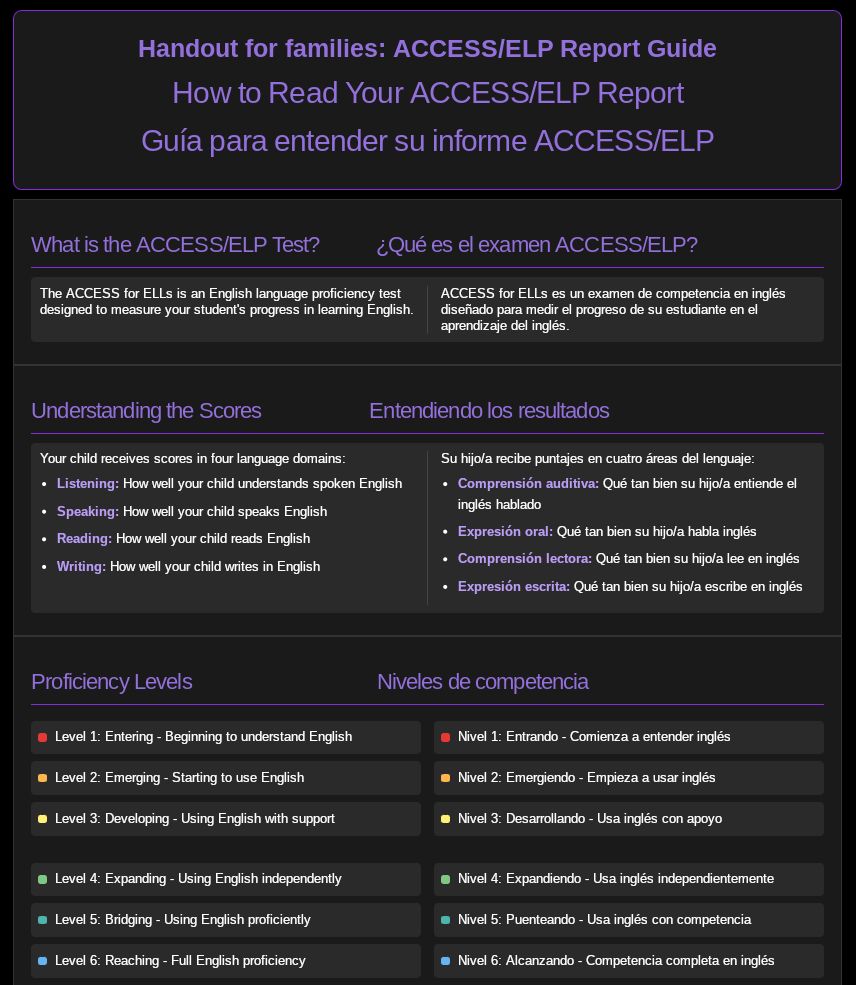
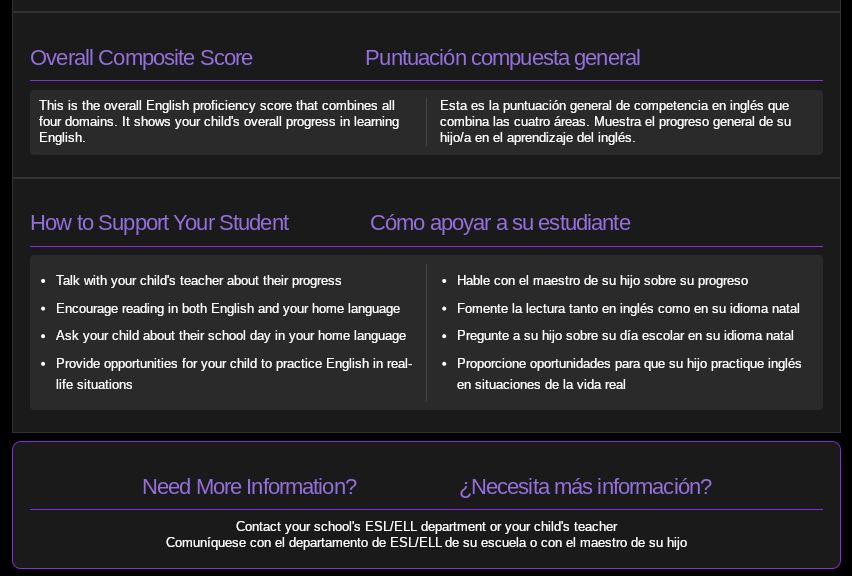
The handout was designed for families as a part of my course.
Policy and Legislation: Staying Informed and Acting Ethically
What to track
- Federal: Title III (ESSA), OCR guidance on language access and civil rights, Plyler v. Doe (right to K–12 education regardless of immigration status).
- State/district: Entry/exit criteria for EL services, assessment accommodations, bilingual/dual-language program policies, grading/reporting guidance.
- Emerging: Seal of Biliteracy criteria, newcomer supports, anti-discrimination and translation/interpretation mandates.
How to stay current
- Subscribe to state EL office newsletters, WIDA updates, and professional orgs (TESOL International, NABE).
- Attend district EL PLCs, webinars, and policy briefings; summarize key updates for colleagues in practical terms.
Why it matters
- Compliance and equity: Ensures students receive mandated services and language access; prevents unlawful practices (e.g., improper denial of interpretation).
- Program quality: Informs staffing, scheduling, and resource allocation decisions that directly affect instruction.
Advocacy: ESL Teacher's Role and Commitments
Student-centered advocacy
- Ensure appropriate placement and services based on comprehensive data; push back on premature exits or inappropriate scheduling that limits access to core/electives.
- Safeguard confidentiality; communicate rights to families in their home language.
Instructional advocacy
- Champion translanguaging and culturally sustaining pedagogy; provide concrete examples and evidence of impact.
- Advocate for materials: leveled texts, bilingual resources, interpretation budgets, and professional learning.
Systems advocacy
- Bring disaggregated data to leadership (e.g., EL participation in advanced courses; discipline disparities) and propose actionable changes.
- Participate in policy review committees; recommend clear language-access procedures and timelines.
Voice and agency
- Elevate student and family perspectives in decision-making (surveys, focus groups, advisory councils).
- Celebrate multilingual achievements publicly (newsletters, showcases, Seal of Biliteracy pathways).
Leadership in Action: Sample Initiatives
Multilingual Access Protocol
Create and roll out a simple, district-aligned flowchart for requesting interpreters, translating key documents, and logging contacts.
Content-Language Planning Cycles
Identify a shared language function, co-create stems/frames and a single-point rubric, test in classrooms, and share results.
Data-to-Action Brief
Compile a one-page brief on EL outcomes (attendance, course pass rates, ACCESS growth), highlight bright spots and gaps, and propose two concrete changes.
Professional Identity Statement
TESOL teacher is a collaborative leader who positions language development as a shared, schoolwide responsibility.
TESOL teacher grounds decisions in student voice, instructional evidence, and current policy.
TESOL teacher advocates persistently and constructively for resources, access, and practices that honor multilingualism as an asset.
Proposed Action Plan
Quarterly
Lead a strategy spotlight for staff; co-host a multilingual family session.
Monthly
Co-plan with each content team and review domain-level progress for focus students.
Biannually
Update a policy cheat sheet for staff (entry/exit, accommodations, translation).
Ongoing
Mentor a colleague in implementing one language-rich routine; document impact.
Resources
- TESOL International and NABE policy updates
- WIDA communications and standards implementation guides
- Colorín Colorado: family engagement and policy explainers
- State EL office newsletters and district EL program handbooks
- Local immigrant and refugee support organizations